Diary

May 2026

James O'Barr's THE CROW
April 2026
T-Men
Excalibur
An unwieldily, overly-ambitious, beautifully rendered epic carried by the grandness of its scale and the confidence in its direction. Review to come.
Point Blank
Bad Day at Black Rock
Bad Day at Black Rock
Bad Day at Black Rock marks two firsts for me—Spencer Tracy and, more significantly, John Sturges (shocking, I know). Set against the backdrop of a wounded postwar America, the film is steeped in McCarthy-era anxiety about silence, intimidation, complicity, and the deep moral cost of looking away—unmistakably shaped by the 1950s, even as its story takes place a decade earlier. Widely recognized as one of the earliest major American films to directly confront anti-Japanese racism in the wake of World War II, Bad Day at Black Rock is a morally corrosive western noir boasting considerable talent both in front of and behind the camera. Spencer Tracy won Best Actor at Cannes for his role as John J. Macreedy—the film’s moral center, and an interesting one at that. He’s not a detective, not a sheriff riding into town, not even blood-related to anyone there—he’s simply a man who refuses to be bullied into blindness in his quest to find out what happened to Komoko, a Japanese resident of the town. The supporting cast is equally strong—from Robert Ryan’s menacing Reno Smith to Ernest Borgnine’s brash, bull-headed Coley Trimble. Funnily enough, Lee Marvin turns up in a small role as Hector David, the silent, menacing figure who sizes up Macreedy throughout the film—a nice surprise after having just watched Point Blank for the first time recently. Alongside Sturges’s wonderfully suspenseful direction, William C. Mellor’s CinemaScope work is integral to the film’s entire identity. Shot on location in Lone Pine, it calls to mind Budd Boetticher’s Comanche Station and how Charles Lawton Jr. utilized the barren, rocky terrain to underscore the loneliness of its protagonist. Mellor makes the town feel constricting and suffocating, its utter isolation pressing in from every angle. There’s nowhere for Macreedy to run, and the town becomes its own special kind of hell. Bad Day at Black Rock was a fantastic introduction to John Sturges, both as a director and as an artist. The film’s influence lingers through the sheer portability of its setup, but the deeper reason it feels so current is that it remains one of the cleanest American films ever made about communal cowardice. ᐅ Watched in 2026 — Ranked (https://boxd.it/RjcIq) ᐅ Westerns — Ranked (https://boxd.it/AEquG)

Fight Club
It’s easy to deride Fight Club as nothing more than a “film-bro” movie nowadays—and in some cases, you wouldn’t be wrong. That’s not the film’s fault, though; it’s the burden of a subset of viewers who woefully misunderstand, or willfully misinterpret, what the film is actually going for. Despite its angry, nihilistic idiosyncrasies, I can never bring myself to talk it down—it’s a damn well-made film. Undeniably one of the defining works of the late ‘90s, Fight Club is a portrait of male dissatisfaction that doesn’t simply diagnose the crisis but dramatizes just how easily that anger can curdle into violent fanaticism or cultish fascism. David Fincher manages to make Tyler Durden’s (Brad Pitt) worldview function simultaneously as seduction and a warning. It’s easy to agree with his critique of materialism, objectification, and societal expectations—but it’s crucial to understand and recognize that the way he and his cronies go about fighting against the machine is just as self-destructive, if not more so. One of the film’s most striking ideas is how rebellion can quickly transform into the very soul-crushing bureaucratic nightmare it claims to oppose. It’s remarkable how much Fight Club is doing while remaining a kinetic, genuinely entertaining piece of cinema. Seeing this in theaters has only deepened my admiration for both David Fincher’s technical prowess and just how precisely the film manages to land its message.
Point Blank
John Boorman is a director I’ve barely scratched the surface of—the only other film of his I’ve seen is Deliverance. By the mid-to-late 1960s, cinema had begun undergoing a transformation, becoming something more violent than what came before. Point Blank, in particular, had long fascinated me, its reputation alone enough to keep it on my radar. Having finally seen it via Criterion’s brand-spanking-new restoration, it’s immediately obvious why it’s regarded so highly. I loved every bit of Boorman‘s esoteric, psychedelic, angry, postmodernist ghost story set in the swingin’ sixties. Lee Marvin’s Walker—a lead of few words—feels less like a human and more like an immovable slab of meat. Walker, quite literally, returns from the dead to exact his vengeance for a paltry sum of money that stops being an objective somewhere along the way and becomes a fixation. Boorman and Marvin bonded over the material, reportedly despising the script they were first handed and reshaping it into something far more formally daring, stripped-down, and bold. For a film this experimental, it needed a strong technical backbone to hold it in place. Philip H. Lathrop’s cinematography is central to Point Blank’s entire force, emphasizing the stark, empty modernist interiors and cold, displaced architecture. The Los Angeles Boorman visualizes here is an impersonal one, indifferent to its inhabitants and their suffering. Ostensibly a hard-boiled crime thriller, Point Blank owes far more to the French New Wave and European modernism than to any standard Hollywood crime pictures at the time. I loved everything about this. Marvin’s near-static performance, Boorman’s surreal and dreamlike direction, Johnny Mandel’s haunting soundscape—Point Blank is one of the most formally distinct films of its era, and it goes straight onto my list of perfect films. ᐅ Watched in 2026 — Ranked (https://boxd.it/RjcIq) ᐅ 1960s — Ranked (https://boxd.it/DCV9i) ᐅ Mise en Scène: Perfect Films (https://boxd.it/bATqq)
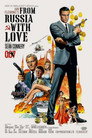
From Russia with Love
Soaked in post-Cold War paranoia, From Russia with Love is the second big-screen adaptation of Ian Fleming’s 007 novels. Once again directed by Terence Young, it sends Bond up against SPECTRE, a shadowy organization exploiting the delicate political tensions between the U.S. and Russia to stoke chaos and confusion, all in the service of profit. Being only the second entry in what would become a decades-long franchise, the series is still clearly finding its footing. This particular film feels far more procedural and indebted to Hitchcock than its predecessor, and frankly, I don’t think that’s the right approach for material as inherently flamboyant as a Bond picture. The runtime weighed on me, I won’t lie, and the thin characterization of Bond and everyone around him didn’t help. Tatiana Romanova (Daniela Bianchi) is reduced to little more than arm candy, squandering what could have been a genuinely compelling double agent whose feelings for Bond develop in secret. Instead, she falls for him so quickly that it’s nearly impossible to tell when she’s even pretending. Donald “Red” Grant (Robert Shaw) is Bond’s dark mirror, a psychopathic, sexually restrained, chillingly disciplined assassin, which makes it all the more frustrating that he’s largely relegated to skulking in the background before finally confronting Bond in the last twenty minutes. Beyond his introduction, one of the film’s best moments, he does little more than posture. From Russia with Love is a disappointing step down from Dr. No, a film I think genuinely captures the essence of what people love about this series. Despite both being shot by Ted Moore, this feels particularly grounded in its depiction of environments, opting for a far more polished look compared to its predecessor. I’d attribute that stark difference largely to the absence of Ken Adam’s production design more than anything. Where Dr. No reveled in art deco and mid-century modernism, From Russia with Love retreats into enclosed spaces. The Orient Express sequence is a particular standout, feeling closer in spirit to Richard Fleischer’s noir masterpiece The Narrow Margin, though the broader suspense mechanics are unmistakably Hitchcockian. There are things to enjoy, I won’t pretend otherwise, but I find Bond simply isn’t a compelling enough chauvinist caricature to anchor a self-serious espionage picture. I understand Goldfinger steers things back toward what I liked about Dr. No, and I’m very much looking forward to it. ᐅ Watched in 2026 — Ranked (https://boxd.it/RjcIq)
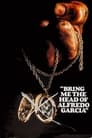
Bring Me the Head of Alfredo Garcia
Sam Peckinpah is a director I’ve only scratched the surface of—The Wild Bunch works incredibly well as a bookend to an entire genre, and Straw Dogs is an unsettling interrogation of violence. Much of his work has eluded me, but Bring Me the Head of Alfredo Garcia in particular has been one I’ve always meant to get to. Maybe it’s the title, but I came in expecting Peckinpah’s explosive bouts of violence throughout—and while he delivers on that front, what’s here is something far more personal. At the center of it all is the surprisingly loving relationship between Bennie (Warren Oates) and Elita (Isela Vega). Bennie, a disillusioned American expat living in Mexico, tries to seize control of his life by delivering the head of a dead gigolo to a Mexican crime lord simply known as El Jefe. He learns from Elita—his girlfriend, a singer, and sex worker—that Alfredo has died unceremoniously in a car accident. Wanting a better life for them both, Bennie brings her along on his mission, convinced the money will be their way out. What makes Bennie such a compelling character is his aloof, pig-headed obliviousness—right up until the film takes a tragic turn. From that point, he undergoes a metamorphosis, slowly reckoning with the life he’s lived, the life he refused to live, and where it’s all left him. Alfredo’s severed head shifts from plot device to something spoiled and almost cursed, haunting Bennie’s every move. Peckinpah’s refusal to play this as the exploitation picture it could so easily have become is precisely what makes it feel so naked and effective. Bring Me the Head of Alfredo Garcia is a film I won’t forget anytime soon. ᐅ Watched in 2026 — Ranked (https://boxd.it/RjcIq)
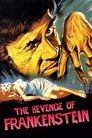
The Revenge of Frankenstein
If Baron Victor Frankenstein really wanted to hide his identity, maybe he shouldn’t have gone with Dr. Victor Stein… I feel it’s worth noting that my Hammer Horror collection spans two separate box sets, so I keep watching these out of order. I hadn’t seen Terence Fisher’s The Curse of Frankenstein before its follow-up (this one), so I may be missing some context, but The Revenge of Frankenstein holds up remarkably well on its own. Critics at the time felt the Baron had softened between the two films, which is curious given that he exploits the destitute poor to facilitate his experiments. That criticism either amounts to a willful misreading, or Fisher really did start him somewhere considerably darker. I’ll just have to see. Anywho—much like the rest of Hammer’s output, The Revenge of Frankenstein is another stylized, colorful entry in the studio’s boundary-pushing catalogue. It’s worth remembering that by the mid-1950s, the horror genre had essentially cannibalized itself, Universal’s classic monster cycle having been reduced to self-parody, with Abbott and Costello Meet Frankenstein as the final nail in the coffin. Hammer stepped into that vacuum at a moment when almost no horror films were being made and seized it. The BFI argues that while The Curse of Frankenstein and Dracula launched Hammer’s horror brand, it was The Revenge of Frankenstein that served as the studio’s true trendsetter—the moment it became confident in its own identity. Peter Cushing reprises his role as the Baron, bringing an aloof, callous, sociopathic energy to the character that stands in stark contrast to Universal’s more sympathetic reading of Shelley’s creation. Frankly (heh), I enjoy Hammer’s take far more, and Cushing gives such a controlled, strongly apathetic performance that the supporting cast can barely get a foothold. They’re decent enough, some even great, but this is his film through and through. One detail I found interesting was how Karl (Oscar Quitak), Frankenstein’s malformed assistant, undergoes a transformation that closely mirrors Victor Carroon’s arc in The Quatermass Xperiment. Whether that’s intentional or purely coincidental, I can’t say, but it’s a connection worth sitting with. It’s great. My dive into Hammer Horror has been so much fun, and Fisher’s work with the studio has been a consistent pleasure to watch. The Revenge of Frankenstein is yet another lurid, transhuman, gothic, grotesque invention from a group of people that simply get it. ᐅ Watched in 2026 — Ranked (https://boxd.it/RjcIq)
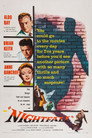
Nightfall
Films that arrive at the end of a movement tend to be the most derivative. Most critics place the classic noir cycle somewhere between 1944 and 1958, which puts Nightfall near the tail end—and yet, despite that and a B-movie classification,Jacques Tourneur does what he always does best and punches far above the film’s limits while receiving almost none of the recognition he deserved. Nightfall never feels like it’s retreading old ground. It goes out of its way to deviate from genre conventions in a number of meaningful ways—the refusal of a voiceover narration and, most notably, the rejection of the doomed romance were two of the first things that caught my attention. Adapted from a 1948 novel by David Goodis—one of the genre’s most distinctive literary voices—Nightfall is sometimes referred to as a “blanc-noir” for the lighter register it inhabits, at times edging toward becoming a caper story. Tourneur directs with confidence, however, ensuring that underlying noir dread stays intact. The only other Aldo Ray film I’d seen was Anthony Mann‘s Men in War, where he played the jaded Sgt. Montana. I really liked him here—there’s an innocent, boyish charm to him that’s easy to gravitate toward. Goodis wrote compulsively about men destroyed by circumstance, and Vanning fits that template perfectly. Anne Bancroft as Marie Gardner also puts a welcome twist on the form, sidestepping the femme fatale entirely to become one of the film’s strongest moral centers—trusting Vanning when the system wouldn’t. The highlight for me, though, were the two bank robbers, John (Brian Keith) and Red (Rudy Bond). Their constant back and forth over the logistics of their crimes was a joy to watch, and Bond‘s Red in particular brings a grinning, impulsive menace that practically steals the movie every time he’s on screen. Nightfall is a lean, mean, economical machine—not a minute wasted across its taut 78-minute runtime. That it isn’t talked about more is frankly baffling to me. ᐅ Watched in 2026 — Ranked (https://boxd.it/RjcIq)
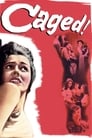
Caged
The women-in-prison genre usually lives and dies by its sensationalism, stripping away any social conscience and leaning almost entirely on exploitation. John Cromwell’s Caged, however, is framed much closer to noir, with its abuse played as horror and its degradation arc as tragedy. The result is something genuinely dark and grim. I was surprised by how deeply this moved me. Eleanor Parker, in particular, gives an all-timer of a performance as Marie Allen, the doe-eyed accessory to her dead husband’s crime. More than anything, Caged is a searing indictment of institutional power and its failure. Warden Benton (Agnes Moorehead) represents the idealistic vision of prison as a place where convicts can be reformed and returned to society, while Matron Harper (Hope Emerson) stands as the direct opposite of that belief. Cromwell’s argument is clear: life behind bars, as it exists, does not rehabilitate so much as hardens. Marie enters prison as little more than a naïve, frightened girl and leaves it as something cold, callous, and hollow. One moment in particular, when her initial parole is denied, was devastating to watch. Parker plays it with such raw desperation that it genuinely got to me. She’s phenomenal, and it makes perfect sense that this was the first of her three Oscar nominations. Caged is also a beautiful-looking film. Shot by Carl Guthrie, the prison becomes a cramped, oppressive space, with bars, grills, and wire fencing constantly swallowing up the frame. Stark shadows press down on the inmates as they stare through the bars at a passing train; in solitary confinement, a face is reduced to almost nothing beyond a single visible eye. It’s fantastic visual work, and genuinely effective at what it tries to do. I watched this on a whim and, truthfully, expected something far more exploitative. Caged is anything but. It feels like the foundational text of the women-in-prison genre, with so much of what followed descending from it. Knowing that Cromwell would be blacklisted from Hollywood the following year over alleged communist ties only sharpens his critique of institutions even further. ᐅ Watched in 2026 — Ranked

Faces of Death
John Alan Schwartz’s original mondo-style documentary Faces of Death—released under the pseudonym Conan Le Cilaire—has lived in infamy since its release. A precursor to the internet era we now inhabit, it forced viewers to confront deeply uncomfortable footage of life being extinguished. Much of the “death” turned out to be staged, but it made its point loud and clear. Daniel Goldhaber and screenwriter Isa Mazzei take the original’s mission statement and co-opt it into something new and equally twisted. Rather than dwelling on death itself, the film interrogates the morbid spectacle of violence in a world where it is so easily accessible, drawing a distinction between desensitization and normalization. The real threat, both argue, is not feeling nothing—but getting used to feeling bad all the time. In retrospect, it’s fascinating to see how provocative Schwartz’s Faces of Death was upon release, given how much worse is now so readily available. On that note, the film has some entirely valid criticisms to make about online moderation—mainly that it fucking sucks. I’m not speaking only to the ineptitude of social media platform’s attempts at making it “safer” (they aren’t), though that’s certainly a large part of it, but also to the downright pathetic efforts at moderating explicit sites like Pornhub—platforms that have become outlets for rape, sexual assault, child abuse, revenge porn, and hidden camera footage. Faces of Death is pointedly focused on the violence, but the wider context is worth raising regardless. Like the film says: give the people what they want. Online algorithms prey on your morbid curiosity, engineered to keep you scrolling for hours on end, cycling through fear, anger, and confusion. Goldhaber leans into that reality right through to the end—a downbeat victory lap that makes willing accomplices of us all. Fucked up. ᐅ 2026 Releases — Ranked (https://boxd.it/RnJfa)
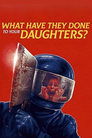
What Have They Done to Your Daughters?
My first Massimo Dallamano film and first foray into the poliziottesco genre, What Have They Done to Your Daughters? is less interested in titillation than in procedural momentum. This isn’t really a surprise, as the giallo genre was losing popularity by the mid-1970s, when political upheaval and civil unrest had become the norm, and films like this reflected a society at war with itself and deeply suspicious of authority. The film follows the investigation into the murder of a young girl who is found to have been involved in a sex ring. As it unfolds, we learn just how deep the rot runs among the upper class and the powerful. What Have They Done to Your Daughters? plays as a hybrid of giallo’s more stylized elements and poliziottesco’s grounded footwork. The nameless killer—clad in black leather and a motorcycle helmet—is deployed economically throughout, which speaks to that balance. Dallamano doesn’t linger on kills, if ever, focusing instead on the cat-and-mouse aspects of the story. The technical craft is just as impressive here. Shot by Franco Delli Colli, the film has a deeply impersonal look, with shades of gray and blue blanketing the frame, punctuated by bursts of deep reds in moments of violence. There’s also one of the best chase sequences I’ve seen in some time, with some truly remarkable shots throughout, some of which feel genuinely dangerous to have captured. Dallamano himself was a renowned cinematographer before turning director, having shot both A Fistful of Dollars and For a Few Dollars More for Sergio Leone, and while he goes uncredited as DP here, I wouldn’t be surprised if he was more hands-on than he might have let on. Stelvio Cipriani’s score is another great addition with the film’s theme, in particular, being a standout—a chipper, wordless piece of music that, given the subject matter, lands as incongruously unsettling. Notably, Quentin Tarantino borrowed from Cipriani’s soundtrack for Death Proof. The longer I sit with this, the more I like it. What Have They Done to Your Daughters?, if anything, gets me excited to go through the rest of Dallamano’s filmography. ᐅ Watched in 2026 — Ranked (https://boxd.it/RjcIq)
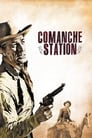
Comanche Station
The final entry in Budd Boetticher’s Ranown Westerns, Comanche Station stars the quietly expressive Randolph Scott. It’s been a pleasure working through these films via Criterion’s 2023 box set and being introduced to Boetticher’s work through it. More than anything, this cycle has deepened my affection for the stripped-down western, right alongside the films of Anthony Mann. Comanche Station, in particular, feels like the perfect bookend both to Boetticher’s collaboration with Scott and to a way of western filmmaking that was already on its way out by this point, soon to be overtaken by the more explosive popularity of the spaghetti western. Boetticher understood that the most compelling conflict was not between good and evil, but between two men who are more alike than different, separated less by morality than by choice. That was simply his way of telling stories, stories rooted in very human truth rather than mythic absolutes, and Comanche Station feels like the fullest expression of that belief. The film follows Jefferson Cody (Randolph Scott), a man whose lonely existence is defined by a purpose that can never really be fulfilled. After hearing a rumor that a woman has been taken by the Comanche during a raid somewhere along the Texas frontier, he sets out to rescue her. We learn through a cruel revelation that Cody’s own wife was taken ten years earlier, and what drives him now is the faint, likely impossible hope that one of these women might somehow still be her. I’ve loved Scott’s screen presence ever since I first saw him in Boetticher’s The Tall T. He carries himself with a weathered, somber stillness that runs through so much of his work. His performance here may be the one that hits me hardest. He does so much through those tired, watchful eyes and that slow, assured swagger. Cody feels like a man at the end of his rope, carrying on because the act itself gives him some shred of agency in an otherwise indifferent world. Knowing this was one of Scott’s final performances before retiring lends the film a sense of finality. It also looks marvelous. Of all the CinemaScope films I’ve seen, Comanche Station feels like one of the most fully attuned to the possibilities of the wide frame. Rather than using it for spectacle, Boetticher uses it to emphasize isolation, not just Cody’s, but that of all the lost souls drifting through the film. Shot on location in Lone Pine, it makes extraordinary use of the Alabama Hills, those towering granitic boulders east of the Sierra Nevada. The gullies and crevices scattered throughout the terrain make the landscape feel closer to a wasteland, coated in dry, dusty stone. In these vast, untamed compositions, the human drama is almost diminished by comparison. Comanche Station is a brooding, near-mythic western and a fitting capstone to one of the great director-actor collaborations in the genre. You can feel Boetticher’s influence running through later westerns, from Sergio Leone to Clint Eastwood and even Quentin Tarantino. This film, in particular, may well be his finest. ᐅ Westerns — Ranked (https://boxd.it/AEquG) ᐅ Watched in 2026 — Ranked (https://boxd.it/RjcIq)
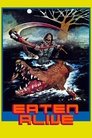
Eaten Alive
For my Easter Sunday film I, naturally, decided on Eaten Alive—Tobe Hooper‘s follow-up to the culturally significant Texas Chain Saw Massacre. Going in, I’d assumed this predated that film, so learning it came after was a genuine surprise. Eaten Alive feels simultaneously like a spiritual successor to and its antithesis. Where Texas Chain Saw Massacre was defined by gritty, grindhouse realism, Eaten Alive is distinctly and deliberately artificial. That artificiality is, I think, the film’s most important and most misunderstood creative decision. Shot entirely on soundstages at Raleigh Studios in Hollywood, Hooper’s intent was to create something closer to a surreal southern-swamp gothic—bathed in neon reds and drowned in constant fog, the film sustains a particular uneasiness throughout. Released just a year before Dario Argento’s Suspiria, it reads now as one of the earliest examples of expressionist horror breaking into the Western mainstream—a sensibility that would carry through into Hooper’s later work, like The Funhouse or Lifeforce. I won’t claim it surpasses Texas Chain Saw Massacre—it doesn’t—but Eaten Alive has a sickly, nasty charm I can’t quite pin down or shake off. Neville Brand’s performance as Judd, the manic, bloodthirsty hotel owner, is genuinely great. Brand himself was a decorated WWII veteran—reportedly the fourth most decorated American soldier of the war—and something of that history bleeds into his unhinged, ranting performance in ways that are hard to articulate but impossible to ignore. A weird, hypnotic film that I can’t help finding oddly great. Hooper’s insistence on creating a farce in the shadow of his most celebrated work is a bold swing, and one I think pays off. ᐅ Watched in 2026 — Ranked (https://boxd.it/RjcIq)

Freaked
In the late 1980s, Joe Roth became head of production at 20th Century Fox. His run was defined by some enormous hits—Home Alone, Die Hard 2, Edward Scissorhands—but he was also known for greenlighting bold, unconventional pictures like Barton Fink and Naked Lunch alongside the mainstream fare. Freaked was among the films he saw potential in, arriving at the exact moment underground and alternative culture was being commodified and absorbed by major studios that, frankly, didn’t understand what they were actually buying. When Roth stepped down and was replaced by Peter Chernin, that enthusiasm disappeared overnight. Chernin had no interest in Alex Winter and Tom Stern’s vision—he slashed the budget and cut the planned wide release to a mere two screens. Freaked ended up making $30,000 against a $12 million budget. A bomb, through and through. It found its audience eventually, through VHS rentals and midnight screenings—the same kind of midnight screening I happened to attend yesterday. I feel I should specify that I am a lightweight when it comes to any type of recreational substances, so when I say that the THC-infused pineapple drink my friend gave me hit me hard, I really, really mean it. I thought Freaked was the funniest thing I’d ever seen. I wasn’t expecting a film this relentlessly paced—it simply does not wait for you, which is both its greatest strength and what may genuinely alienate some expecting a conventional pace. I was also surprised by how well the effects, prosthetics, and makeup hold up for a film that had its budget substantially gutted. In the third act, when Ricky Coogan (Alex Winter) and Stuey Gluck (Alex Zuckerman) transform into towering, troll-like abominations, the sheer scale and fluidity of the animatronics is genuinely astonishing. Beyond the dark comedy, those effects are Freaked’s crowning achievement—Screaming Mad George, Tony Gardner, Steve Johnson, and Chiodo Brothers Productions were all brought in to contribute, every one of them veterans of far bigger productions. I can’t fully convey how much fun this was with an audience, but I’m certainly trying. Freaked is a miracle of a film, and I’m glad I got to catch it on the big screen. ᐅ Watched in 2026 — Ranked (https://boxd.it/RjcIq)
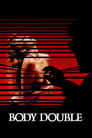
Body Double
Fresh off the cultural touchstone that Scarface had become, Brian De Palma set out to make a film that would give the MPAA, in his own words, “everything they hate and more of it than they’ve ever seen.” I feel that statement sums up Body Double—a film engineered to provoke—about as succinctly as possible. Columbia offered De Palma a three-picture deal on the back of Scarface, with Body Double being the first and last film to emerge from it. Despite its considerable artistic merits, it was a financial failure on release—releasing the same day as James Cameron‘s The Terminator didn’t help its box office. Critics compounded the damage by dismissing it as derivative of Alfred Hitchcock‘s Rear Window and Vertigo. On the surface, that charge isn’t entirely incorrect, but the homage is the point. De Palma borrows Hitchcock‘s own cinematic grammar and turns it back on itself, using those storytelling mechanisms to examine how they entrap and implicate the audience. The film is also more intimate in its treatment of its victim than its Hitchcock counterparts. Gloria Revelle (Deborah Shelton) is stalked by both Jake Scully (Craig Wasson) and a mysterious, genuinely terrifying presence, lending the film a deeply toxic voyeurism through its sexual objectification while De Palma forces us to soak in the male gaze’s insatiable appetite. Transgressive and entirely self-aware, Body Double constantly reminds us we’re watching a film. It was De Palma‘s most aggressive assault on the MPAA limits he’d been pushing against throughout the late 1970s and early 1980s—and it’s a near masterpiece. ᐅ Watched in 2026 — Ranked (https://boxd.it/RjcIq)
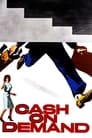
Cash on Demand
Adapted from Jacques Gillies‘s The Gold Inside—a 70-minute ITV television play also directed by Quentin Lawrence—Cash on Demand is arguably one of Hammer’s finest films, though at the time a psychological crime picture in black and white from the studio of Horror of Dracula and The Curse of Frankenstein was never going to be an easy sell. For a taut 80 minutes, bank manager Harry Fordyce (Peter Cushing) undergoes his own version of A Christmas Carol, refracted through the meticulously planned robbery of one Colonel Gore Hepburn (André Morell). Fordyce is, as the type demands, a curmudgeon—a stickler for the smallest infractions, wholly detached from the lives of the people around him. Hepburn, funnily enough, is warmer and kinder toward the bank’s employees than Fordyce has ever managed to be. And while he may be no ghost, Hepburn performs the same structural function as Dickens’s apparition: a figure from outside Fordyce’s ordinary world who forces him to confront what he has allowed himself to become. The story never leaves the bank, and Lawrence, like so many Hammer directors before him, makes the best possible use of that constraint. Arthur Grant’s cinematography transforms the building into its own closed world—all hard lines and enclosed spaces pressing inward—as Cushing’s nervous performance grounds the story with a quiet authority. Time has been kind to Cash on Demand. It’s now regarded as one of the finest British crime dramas of the early 1960s, and much like the rest of Hammer’s output I’ve seen, it rises well above its B-movie counterparts. ᐅ Watched in 2026 — Ranked (https://boxd.it/RjcIq)